NIH Blueprint: The Human Connectome Project

News and Updates

Upcoming events | May 15, 2012

HCP at OHBM 2012

OHBM 2012

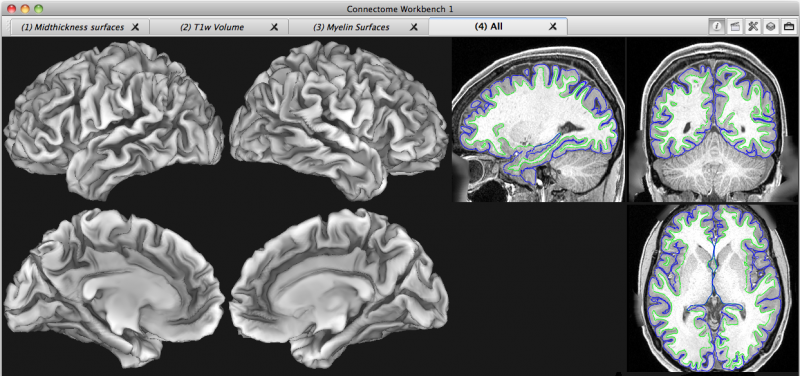
This year’s OHBM conference comes at a time when our project is in the middle of an exciting transition. We are preparing to begin Phase II of the project, in which we collect scan data from 1,200 human subjects, and will soon release Phase 1 Pilot Data for the scientific community at large. In addition, we have an early release of a powerful open-source software tool to debut: Connectome Workbench, which allows users to explore connections in the brain in three dimensions.

Here is a rundown of the HCP presence at this year’s Human Brain Mapping conference.

Educational Course: “The Connectome”

HCP investigator Heidi Johansen-Berg (Oxford University) will be co-leading a comprehensive two-part course on building and data-mining the connectome. Additionally, HCP investigators David Van Essen and Mark Woolrich will be lecturing on key components. According to the course curriculum, attendees will successfully be able to:

  1. Understand methods for acquisition and analysis of diffusion MRI, resting state FMRI, EEG and MEG data;
  2. Understand network modelling methods for connectomics;
  3. Give examples of approaches to visualising connectomes; and
  4. Give examples of applications of connectomics to understanding brain function and dysfunction.

Educational Course: “Imaging Genetics”

HCP investigator Thomas Nichols (University of Warwick) will be co-leading a course on the emerging realm of imaging genetics for OHBM 2012 attendees. With a cohort of 1,200 subjects made up of twin and non-twin siblings, the combined imaging and genetic data assembled Human Connectome Project will provide a trove for future analysis. According to the course prospectus, attendees will be able to:

  1. Understand the fundamentals of the molecular basis of genetic variation, and how that variation is modeled in traditional genetics studies.
  2. Understand the difference between linkage, association and heritability analyses.
  3. Understand the relative strengths & weaknesses of each different type of brain imaging phenotype used to find genetic association.
  4. Understand how imaging genetics can be applied to areas like schizophrenia or Williams’s syndrome.

More HCP-related talks:

In addition to these two full courses, there will be ample opportunities to be enlightened on connectome-related topics.

Sunday Courses: David Van Essen (Washington University in St Louis), Christian Beckmann (Oxford University), and Noam Harel (University of Minnesota) will be speaking as part of courses on the anatomy of the brain and its impact on imaging, as well as resting-state fMRI.

Monday Symposium: Heidi Johansen-Berg will be presenting “Dynamic Changes in Neurochemistry and Brain Structure with Learning and Brain Stimulation” as part of a symposium on what brain imaging can tell us about motor learning.

Tuesday Symposium: Maurizio Corbetta (Washington University in St Louis) will be presenting “A Frequency-Specific Mechanism that Links Human Brain Networks During Task Performance” as part of a symposium on relationships between functional networks assessed by fMRI and EEG/MEG/ECoG.

Wednesday Symposium: Essa Yacoub (University of Minnesota) will be presenting “Mapping Columnar-Level Organizations in Human early Visual Areas with Ultra-High Field fMRI” as part of a symposium on cracking the columnar-level code in the visual cortex with ultra-high field fMRI.

HCP Poster Presentations

Floorplan

Visit us at Booth 206

A variety of posters from HCP investigators and colleagues will be on display at OHBM 2012. We will update this site with a full schedule of posters and speaking times when it becomes available.

HCP Booth 206: Software Demos and more

Connectome Workbench (beta 1 release): This powerful open-source tool allows users to visualize connectivity data on both the surface and interior volume of the brain, and provides a series of tools to amplify research tasks.

HCP Pilot 1 data and HCP TFM Release 1 data: For those of you who have not had a chance to explore the Human Connectome Project’s pilot data releases, see them in use as we walk through our software demos.

For more information, visit the OHBM 2012 website.

Posted by Will Horton @ 10:18 am

Project News | March 29, 2012

Van Essen featured on NPR, comments on new study by Wedeen et al.

HCP Principal Investigator David Van Essen appeared today on National Public Radio’s afternoon news program All Things Considered in an interview with Science reporter Jon Hamilton.

Wedeen et al., 30 March 2012, Science

Dr. Van Essen commented on a new study appearing in the March 30 edition of Science by Van Wedeen at Harvard University/Massachusetts General Hospital and colleagues entitled “The Geometric Structure of the Brain Fiber Pathways”.  The authors studied the brains of four non-human primate species and humans using diffusion MRI (a major imaging modality being employed in the HCP) to determine the architecture of white matter fiber tracts that connect brain regions to each other.

The authors propose that cerebral fiber pathways in the brain intersect perpendicular to each other, creating a three-dimensional grid layout. This architecture, Dr. Wedeen says, can explain how the brain evolved complexity over time:

The grid model could help answer a question that has baffled geneticists and biologists for years, Wedeen says: How can a relatively small number of genes contain the blueprint for something as complex as the human brain?

The answer may be that in a highly organized grid system with consistent rules, a genetic blueprint doesn’t have to describe every detail of the final product, he says.

“The grid structure shows how simple recipes can produce a very complicated outcome,” Wedeen says.

The grid also may help explain how the rudimentary brain of a flat worm evolved into the complex brain found in people, Wedeen says.

The grid system, he says, would allow a species to gradually add new functions to its brain much the way an architect adds extra floors to a building or a city planner adds new streets.

“So you actually see the tools through which evolution builds a complicated human brain from more simply constructed ancestral brains,” he says.


Dr. Van Essen responded to the study with some skepticism and optimism that clearer, more definitive answers for human brain architecture are coming soon with the efforts of the Human Connectome Project:

The results of the new study are surprising and intriguing, but not yet certain, says David Van Essen, a neuroscientist at Washington University School of Medicine in St. Louis.

“The evidence for their hypothesis is strong to some degree,” Van Essen says. But he adds that “in a couple of important ways I think they may have oversimplified the story.”

Take all those 90 degree intersections, for example.

Other studies show that the brain’s structure also includes some diagonal pathways as well, Van Essen says. So he says it’s possible the brain is neither pure spaghetti nor a perfect grid.

“I expect it will turn out to be somewhere in between,” he says.

A definitive answer about the structure of the brain’s wiring probably isn’t far off, Van Essen says, thanks to something called the Human Connectome Project. It’s a five-year brain-mapping effort supported by the National Institutes of Health.

Those findings should help explain how our brain wiring makes us who we are, Van Essen says, and what goes wrong in disorders like autism and Alzheimer’s disease.


Read and listen to the NPR story in its entirety here.

Read the full text of the article “The Geometric Structure of the Brain Fiber Pathways” in Science here.


Posted by Jenn Elam @ 8:02 pm

Recommended Reading | March 2, 2012

Book review: Olaf Sporns’ “Networks of the Brain” reviewed by American Scientist Online

functional connectivity matrix

A functional connectivity matrix is one way of mapping network connections in the brain.

Olaf Sporns, one of two co-coiners of the term “connectome” and an investigator in the Human Connectome Project, is well-positioned to speak on the advances in the field of neuroanatomy over the last twenty years. In Networks of the Brain, published last fall from MIT press, he does exactly that.

Terrence Sejnowski recently reviewed Networks of the Brain for American Scientist Online. In so doing, Sejnowski offers a succinct review of the advances in this field, such as diffusion tensor imaging modeling of white matter fibers, producing images  that have become nearly synonymous with the Human Connectome Project. However, the focus of this book, and Sejnowski’s review of it, is not directly related to any particular imaging modality. Rather, the more abstract field of network science receives the most attention.

Writes Sejnowski:

We have known for some time that there are relatively few long-range connections in the brain, and for good reason: If all 10 billion cortical neurons in the human cerebral cortex were connected with each other, the brain would be the size of a football stadium. As a consequence, the brain’s connectivity pattern is locally dense and globally sparse, following a pattern called a small-world network. The small-world effect was first documented empirically in social-network experiments by Stanley Milgram in the 1960s, and it gave rise to the idea that you are connected to anyone else in the world by no more than “six degrees of separation” through a chain of mutual acquaintances. More detailed analysis of brain structures has revealed interlocking clusters of areas that are responsible for the major brain functions, such as our sensory, motor and planning systems.

In addition to Sporns’ book, several other HCP publications tackle this very subject. These include Tim Behren’s and Olaf Sporns’ “Human Connectomics,” published in Current Opinions in Neurobiology, and “Functional Network Organization of the Human Brain” by Jonathan Power et al, published in Neuron.

Of course, even if we had a complete “wiring diagram” of the brain, the work of connectomics would be in no way complete. As Sejnowski writes: “Creating a complete map of the human connectome would be a monumental milestone but not the end of the journey to understanding how our brains work. The achievement will transform neuroscience and serve as the starting point for asking questions we could not otherwise have answered.”

Posted by Will Horton @ 11:50 am
Older Posts »